Abpolecon.ca welcome contributions. Email: ascahll@gmail.com
The opinions of the contributors do not necessarily represent opinions of Abpolecon.ca
Lennie Kaplan is a former senior manager in the Fiscal and Economic Policy Division of Alberta’s Ministry of Treasury Board and Finance (TB&F) where, among other duties, he examined best practices in fiscal frameworks, program reviews, and savings strategies for non-renewable resource revenues. He served as a policy advisor to the Alberta Financial Investment and Planning Advisory Commission and served as Executive Director to the MacKinnon Panel on Alberta’s Finances.
Cleaning its up own precarious finances is one way for the UCP to create the conditions to attract pipeline investment

Alberta Premier Danielle Smith penned a recent Financial Post column essentially admitting that balancing the provincial budget in the future will be almost entirely dependent on new royalties created from increasing Alberta oil production, presumably facilitated by the federal government signature on a memorandum of understanding (MOU) for new pipeline development. While the Grey Cup day initial deadline for an MOU has since passed, and we now await the events of later this week, we also wait in anticipation for Alberta government’s 2025/26 second quarter fiscal update, due this week, as well.
Getting pipelines built encompasses many different facets, including market-based factors, and thorough private sector-led risk assessment around egress supply and demand issues And, while clearing away bad federal laws, policies and regulations that discourage private sector investment is critical, a commitment from Alberta governments to sustainable public finances-that is, balanced budgets, long-term savings, and paying down the debt is also very important. Investors value economic stability and certainty when they make investments decisions and government living within its means helps reduce risks. The Alberta government’s current and potentially future fiscal track record is hardly stable and certain. Alberta finances are again at a crossroads. Highly problematic is the promise of keeping taxes low which has been part of conservative government’s fiscal gospel since 2000, while acceding to growing demand for public services given large international and interprovincial immigration.
This leads to the obvious question: Is the Smith government really relying on Prime Minister Mark Carney to balance the provincial budget?
I have long been a strong supporter of growing Canada’s oil and gas sector, going back to the days of the Alberta Chamber of Resources and the National Oil Sands Task Force, from 1993 through 1995. And, I am not saying that governments (federal or provincial) should restrict oil or gas production in Canada, directly or indirectly. In fact, I have long believed that oil and gas revenues should be treated as non-renewable and be progressively deposited “off the top:” into the Alberta Heritage Savings Trust Fund, and not used to support current budgets.
Balanced budgets, generating long-term savings from oil and gas revenues, and paying down the debt should be deemed important by the Alberta government to create the right conditions for private sector investment in new pipelines. Premier Peter Lougheed knew this and so did Premier Ralph Klein.

Revised assumptions show difficult challenges
I now estimate that the Alberta government’s annual budget shortfalls are $7.7 billion in 2025/26, $8.8 billion in 2026/27, and $7.5 billion in 2027/. These estimates are based on more prudent assumptions for West Texas Intermediate (WTI) oil prices – US $62.15 per barrel in 2025/26, US$65.00 in 2026/27 and US$67.00 in 2027/28, while using more prudent lower scenarios for Alberta nominal GDP, real GDP, and employment, a higher scenario for the Canada-US exchange rate, balanced by an offset for a lower WTI-WCS differential. Operating expenses over the next two years (2026/27 and 2027/28) are now estimated to grow at the combined annual rate of inflation and population (3.6%), after growing by a projected 4.8% in 2025/26.
These budget shortfalls don’t include about $1.5 to $2 billion in projected annual net cash requirements that will need to be funded by provincial government borrowing. Without any significant fiscal adjustments over the next two years, Alberta’s net financial debt would increase from $34.3 billion (7.7% of GDP), as of March 31, 2025, to $62.8 billion (12.2% of GDP), as of March 31, 2028, a rise of $28.5 billion or 83%. While the Alberta government may claim that Alberta’s projected net debt-to-GDP ratio is still the lowest in Canada, as of 2025/26 (Saskatchewan is next at 14.8%), that is a “borrowed” cliché from a previous Alberta government.
The Smith government could well need to make massive $5 to $6 billion in annual spending and revenue adjustments, even assuming rather brisk overall provincial revenue growth, to balance the books over the next three years (2026/27 to 2028/29).
This shows how deeply the GOA depends on volatile oil revenues. Oil and gas revenues have averaged an astounding $20 billion per year over the past four fiscal years (2022/23 to 2025/26), and yet we are back in the proverbial “budget deficit soup” again this year.
Just imagine if non-renewable resource revenues had averaged a still rather impressive $13 billion per year over the past four years, instead? The Alberta government would have run actual deficits every single one of those years. $13 billion in annual non-renewable resource revenues and the Alberta government can’t even balance its budget! That is astonishing and should concern every Albertan, One of the real culprits here is not a lack of oil and gas revenues, but runaway provincial operating spending (net of COVID-19), which has increased by an astounding $15.5 billion or 31% over four years, an average of nearly 8% per year. That’s even faster than operating expense increases incurred during the last four years (2011/12 to 2014/15) of the Stelmach-Redford era – a $9.1 billion or 28% increase, an average of 6.9% per year.
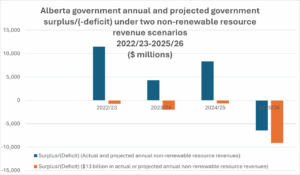
Source: Alberta Budget 2025, Alberta 2025/26 First Quarter Fiscal Update and Economic Statement, and Government of Alberta Annual Report, 2025/26
Solutions
There is a solution to this problem, and, in my opinion, it’s not turning to the Ottawa Liberal government to balance Alberta’s provincial budget. Rather than fueling its spending with more oil money, the Smith government needs to take a harder look at its own runaway spending habits and make the hard adjustments, as required, to assist in getting the budget back into balance over the next three years.
Little public visibility of Cabinet Committee
In this respect, the Alberta government’s “cost-cutting” cabinet committee, known as the Productivity Review Cabinet Committee (PRCC), has been working in relative secrecy for over two years, but Albertans have seem little in terms of tangible results. Another FOIP request to Executive Council on recent work done by the PRCC does reveal 131 (of nearly blank) pages with apparent communication between a number of senior officials within the Alberta government, a reference to a philosophical change in approach to PRCC this year, what is termed Program and Service Delivery Initiatives, and strategies to mitigate associated pressures, but little else. Don’t Albertans deserve to know what expenditure reductions are on the table for health care, K-12 education, advanced education, seniors’ programs, and social services? At the very least, the Alberta government should provide a chapter or annex on the work of the PRCC in the provincial budget documents, similar to the federal government, and a separate and detailed stand-alone report at fiscal year-end in conjunction with the release of the Government of Alberta annual report.
I sure hope that the Smith government’s fiscal strategy and policies has not been reduced simply to demanding that Mark Carney and the federal Liberals balance Alberta’s budget through the expected MOU. We are better than that as Albertans. . . As a prominent Alberta fiscal policy observer once noted:
“Whenever we have this regular budget calamity, commentators always bemoan the lack of diversification in the Alberta economy. But that’s not really the problem. The problem is not a lack of diversification in industry, the problem is a lack of diversification in the provincial government’s source of revenues, and a lack of innovation in the public service as a whole”.
( Danielle Smith writing for the School of Public Policy, University of Calgary in a 2021 paper on Alberta’s Fiscal Future, Pre-publication series. June 2021)
In conclusion, the Smith government must put a realistic 3-year balanced budget plan on the table for Albertans to consider during its February 2026 budget and then follow through on it. Cleaning up the Alberta government’s precarious finances is one sure way to create the conditions for market-based, private sector investment in new pipelines.
Related Posts
Smith’s ambitious oil sands production targets and GHG emissions- Guest Post
Is up-to-date information on Alberta’s finances being presented to investors? Guest Post
What Climate Crisis? Canada’s Message to COP 30 – Watch Us Increase Oil Sands Production- Guest Post