Lennie Kaplan is a former senior manager in the Fiscal and Economic Policy Division of Alberta’s Ministry of Treasury Board and Finance (TB&F). In 2007, he served as a policy advisor to the Alberta Financial Investment and Planning Advisory Commission and in 2019, Mr. Kaplan was Executive Director to the MacKinnon Panel on Alberta’s Finances.

Abpolecon.ca welcomes contributions Email ascahll@gmail.com
Mandate letters
Premier Danielle Smith’s instructions to the Minister of Energy and Minerals to develop a roadmap to reach 8 million barrels per day of Alberta oil production by 2035 will likely result in rising absolute levels of greenhouse gas (GHG) emissions in the oil sands sector. This will have major implications for the pace of deployment for carbon capture, utilization and storage (CCUS) needed to reach overall carbon neutrality in Alberta by 2050, while still unlocking new pipeline development, all part the Ottawa-Alberta “Grand Bargain Memorandum of Understanding (MOU)”.

The “Grand Bargain MOU” is apparently being negotiated by a 6-member Alberta delegation or special negotiating team , co-chaired by Ministers Jason Nixon and Rajan Sawhney, tasked with “securing approval for a bitumen pipeline to the west coast and the repeal of all Trudeau-era anti-resource development laws damaging the Alberta economy“, operating under the auspices of a federal-provincial working group.
It is difficult to find any credible forecast close to the level of oil production in Alberta by 2035 given current realities prevailing in world oil markets. For a good summary of recent oil sands production forecasts, please see the following. Nevertheless, let’s assume this level of Alberta oil production is achievable by 2035 and examine some of the implications involved in terms of projected GHG emissions in the oil sand sector.
Clearly, most of the Alberta oil sector GHG emissions increases over the next decade will occur in the oil sands sector, as it becomes an even larger proportion of Alberta’s total oil production, over time. In fact, conventional oil production in Alberta has been relatively constant at around 500,000 to 550,000 barrels per day over the past number of years. The rise in Alberta’s oil production continues to be driven almost exclusively by the oil sands sector.
Using oil sands production (millions of barrels per day) projections from the latest Canada’s Energy Future Report and emissions intensity (kgCO2e/barrel) data from the latest Government of Canada National Inventory Report, as a starting point, we scale up Alberta oil sands production from 3.1 million barrels per day in 2023 to 5.5 million barrels per day in 2030 and 7.5 million barrels per day by 2035. Between 2023 and 2035, we assume oil sands emission intensity falls by 3 percent per year (rather ambitious), going down from 76.3 kgCO2e/barrel) in 2023 to 63.5 kgCO2e/barrel in 2030 and 53.0 kgCO2e/barrel in 2035. We also assume that the Pathways CCS project is operational by 2030 and reduces emissions in the oil sands sector by 22 megatonnes (Mt) per year by 2030 (this includes CCS, process improvements, solvents, electrification, fuel substitution, and energy efficiency), 45 Mt per year by 2040, and ultimately achieves the goal of net-zero emissions from its operations (about 80 Mt per year) by 2050. Thus, according to this schedule, we estimate GHG emission reductions from Pathways at 33.5 Mt per year by 2035.

As a result of scaling up Alberta oil sands production from 3.1 million barrels per day in 2023 to 7.5 million barrels per day in 2035 and netting out the annual GHG emissions reductions from Pathways, I estimate that oil sands sector absolute GHG emissions will rise from 86.5 Mt in 2023 to 101.7 Mt in 2030 and 111.6 Mt in 2035. These estimates could be understated given uncertainties around federal and provincial government climate change policies and regulations. But, in effect, the dramatic growth in oil sands production far outpaces improvements in emissions intensity, leading to an absolute rise in GHG emissions in the oil sands sector by 2035. The Alberta oil sands emission legislated limit of 100 Mt annually could be breached by 2030.
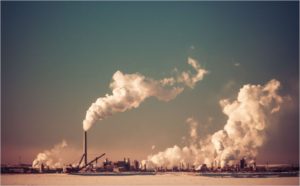
Absent some very aggressive uptake of CCUS in the overall Alberta economy (an estimated 49 Mt in 2030, an estimated 67 Mt in 2035, and an estimated 98 Mt in 2050) and the early advent of Direct Air Capture (DAC) (an estimated 37 Mt in 2050), which would likely require significant additional fiscal incentives from governments, the goal of a carbon neutral Alberta economy in 2050 will be very difficult to achieve.
In the spirit of openness and accountability, the Alberta government needs to release detailed economic modeling and analyses that show the impact its oil production target of 8 million barrels per day by 2035 will have on absolute emissions in the oil sands sector between 2023 and 2050.
Related Posts
Despite soaring profits, oil companies are not paying enough for their environmental damage