Note to readers: The comments section below is now functioning. Please feel free to comment on any of my scribbling. I would like to hear what you think.
Key take-aways
- Smith is directing most of her MLAs to forge ties with American, not Canadian, legislators.
- Smith and her Environment minister Rebecca Schulz and Energy minister Brian Jean are tirelessly promoting Alberta’s responsible energy development. The fundamental goal is to drive infrastructure investment in order to double bitumen production primarily to exported to the U.S.
- Smith and her ministers appear to be losing patience with federal intransigence or non-responses to Alberta fundamental demands on energy and environmental regulation.
Introduction
Nearly every day I receive one to half a dozen statements or news releases from the Government of Alberta (GOA). It is a handy service and easy to subscribe to- https://www.alberta.ca/news. This means each year I receive from one thousand to nearly two thousand messages of some import from the GOA. Many are statements recognizing a particular religious holiday. Others include notices about Alberta Serious Incident Response Team (ASIRT) investigations into incidents involving police, including fraud or homicide. Many relate to trips by government MLAs or ministers to various destinations for particular purposes. The ones I follow concern substantive policy decisions or reporting about government operations like the Heritage Fund.
Much of Premier Smith’s day must be taken up with reading draft press releases or getting ready for news conferences given these volumes. As She is the best political communicator for the government, I pay close attention to the substantive releases in order to detect any new themes emerging for the government. Since media editors and producers are faced with many developing stories, government stories, as opposed to opposition stories, tend to get the most attention. Why? Because government statements or stories are likely to have impact on communities, the economy, or society in general whereas opposition releases are usually about what the government is doing wrong or ideas for better policy. These latter stories are unlikely to get much take-up in the media.
Canada as energy superpower
This Post analyzes major releases in the past eight weeks with the underlying theme of Alberta as an energy superpower. Since the federal election there has been much buzz from the Alberta premier and the business community and their press agents about Canada becoming an energy superpower. Since Alberta is by far Canada’s oil and fossil gas province, the Smith government focus has been on building more pipelines for an expanding oil and fossil gas industry. As Smith declared provocatively earlier this year, they wish to see the province double production.
A recent op-ed by BMO CEO Darryl Whyte in The Globe and Mail is a good example of the enthusiasm of Canadian financiers on the prospects and profits of underwriting large oil and gas projects- “Canada has a rare chance to become an energy superpower. Let’s not squander it”. In this opinion piece White repeats the preposterous statement by former Scotiabank CEO Brian Porter “the last barrel of oil should be a Canadian one.”

It defies logic that the oil sands would still be operating as demand crests and falls and the Saudis continue to pump out the cheapest oil on the planet. Be that as it may for the future, Suits are circling energy infrastructure deals although no private sector proponent has stuck their heads over the parapet. Doubtless they are waiting for governments (Alberta and Canada principally) to signal they are willing to pledge financial support (loan guarantees, direct investment, grants, etc.) to foster more of this infrastructure. This will be infrastructure which will ultimately be stranded likely leaving the public purse with vast reclamation liabilities.
What the GOA has been up to
Let’s follow recent announcements by the Smith government on the theme of energy superpower.
09 July 2025: Putting Alberta at the centre of U.S. energy talks
Backbench MLA Chantelle de Jonge (Chestermere-Strathmore) is traveling to “join state legislators from across the U.S. in training from July 10 to 15 to gather the latest insights on North America’s energy ecosystem, and emerging challenges and opportunities driving current U.S. energy policy and decision making.”
Her message (meaning Ms. Smith’s message) to fellow legislators?
“I will take every opportunity to engage and promote how our province can provide reliable and sustainably produced energy to our partners in the U.S. It is time to find common ground and work together to seize the incredible energy opportunities in front of us. Current global events have brought a lot of uncertainty, but one thing remains clear – Alberta stands ready to partner with the U.S. to achieve our global energy ambitions.” (emphasis added)
The italicized part is a key message from Smith to her subordinates. It should be understood in Ottawa, that if the federal government does not facilitate Alberta’s aspiration as a global energy superpower, we hope the U.S. will. It is not too far a stretch to read annexation or 51st state.
07 July 2025: Alberta-Ontario MOUs fuel more pipelines and trade
This blockbuster announcement was short on details but had all the festive quality that you expect from a Calgary Stampede media event. Two memorandums of understanding were signed, the most significant was a joint “commitment”
to strengthen interprovincial trade, drive major infrastructure development, and grow Canada’s global competitiveness by building new pipelines, rail lines and other energy and trade infrastructure.
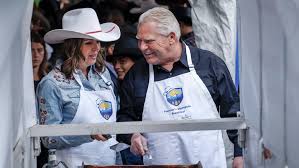
Smith knowing this MOU was essentially meaningless called on the federal government to among other things: the Electrical Vehicle mandate, the non-pipelines law, the tanker ban, the electricity regulations, and emissions cap.
The release also observed the alignment of these “open for business” governments- These agreements build on Alberta and Ontario’s shared commitment to free enterprise, economic growth and nation-building. While the premiers pledge to “engaging with Indigenous partners,” there is never a land acknowledgement. It remains to be seen whether the MOU will fuel more pipelines or trade.
25 June: Taking carbon capture to new heights
The TIER fund aggregates payments from heavy emitters to recycle to the energy industry broadly defined to burnish Alberta’s poor environmental reputation. Under this announcement Deep Sky will supposedly find “a potential new way of removing greenhouse gas emissions straight from the air.”
11 June: Canada top energy supplier for G7: Premier Smith
Here Smith recites findings from the recent Ipsos poll ranks “Canada as the top preferred oil supplier among our G7 allies and the world.”
As we welcome world leaders to Alberta for the G7 Leaders’ Summit, we will showcase exactly why Alberta is the answer to achieving global energy security.
11 June: Nobody beats Alberta drilling
The announcement sings the praises of Alberta’s oil patch which requires further financial assistance to bring many “promising technologies and products have challenges reaching the market due to high costs and limited access to demonstration sites where testing can be done in real-world settings.” Through the TIER fund which recirculates money primarily from the fossil fuel industry to the fossil fuel industry “more than” $20-million is provided to “keep pushing Alberta’s drilling expertise to greater heights.”

The Environment minister Rebecca Schulz is quoted in the release as is CEO of Emissions Reduction Alberta Justin Riemer who tries to explain why this funding will help the environment.
Drilling technology is highly relevant to Emissions Reduction Alberta’s mandate, as it offers a potential pathway to direct emissions reduction in the oil and gas sector while also playing a critical role in commercializing technologies in emerging areas like geothermal and critical minerals extraction.
09 June 2025: The answer to global energy security
This release coincided with the 2025 Global Energy Show in Calgary “attracting leaders from around the world.” Smith and her energy minister Brian Jean were there in Calgary “to welcome international delegates and promote Alberta’s responsible energy development” (emphasis added). Jean noted: “The world needs reliable, responsible and affordable energy from a producer they can trust. Alberta’s vast resources are positioned to meet long-term energy demand and will be key in obtaining North American and global energy security and helping defeat energy poverty.”

Central to the promotional effort is to convince the world energy community that Alberta is a responsible player. The divestment of foreign energy giants producing in the oilsands (except Exxon Mobil) who have made decisions about the optics of producing bitumen counter the argument of environmentally responsible development. That said, who owns the big four oilsands producers? Mainly U.S. institutional investors.
5 June 2025: Wrong signal, wrong time: Minister Schulz
In this release the Environment Minister, Rebecca Schulz criticized the federal Competition Bureau’s guidelines.
The Competition Bureau has moved forward on unleashing extreme, ideological guidelines that will hurt Canada’s economy, silence our hard-working businesses and punish families from coast to coast to coast. The guidelines will not reduce emissions or improve environmental performance, but they will make it harder for companies to attract investment and make our country less globally competitive, once again.
Schulz continued:
This federal government for years has freely allowed anti-energy and anti-business activists to spread misinformation and false claims with impunity, while effectively silencing and putting an undemocratic gag order on the very businesses working to reduce emissions, build pipelines and grow our economy.
Ms. Schulz’s invective concluded by warning Prime Minister Carney that in order to build projects these guidelines “should be scrapped.” This release is a significant development in the nascent relationship between the Alberta and federal government. Carney, who was the U.N.s envoy on climate change and in charge of Brookfield’s “transition funds,” no doubt understands better than Smith and Schulz the nature of false claims and their magnitude. That the new Carney administration is not overly receptive to the Alberta government arguments is significant.
5 June 2025: Removing barriers for Alberta’s Oil Rigs
The same day, Energy minister Jean and Devin Dreeshen, Minister of Transportation and Economic Corridors announced a new Memorandum of Agreement (MOA) between the GOA and the Canadian Association of Energy Contractors (CAOEC). The MOA allows rigs to bypass repeated stops and Vehicle Inspection Stations. According to the release, CAOEC “members have significant training protocols and a high compliance rate with current regulations.”

As Mark Scholz, CEO of CAOEC stated, perhaps tongue in cheek “The Alberta government listens to our needs and demonstrates a truly action-oriented approach, strengthening Alberta’s energy sector and supporting our hardworking crews every step of the way” (emphasis added).
Note the reference to action-oriented and hardworking crews. These are signals that a true Albertan is one that is hardworking and action-oriented. This reinforces the image that Common Ground research has highlighted- that Albertans are the white males who work in rural Alberta. This signaling plays well to rural populations often felt ignored by urban elites.
4 June 2025: Report shows Alberta producing more oil and less emissions
Rebecca Schulz took the lead in this bit of misinformation which Ian Urquhart eviscerated in the Tyee. Here are the following claims of Schulz:
- Overall emissions have declined by nine per cent since 2015, while overall energy production increased by 20 per cent.
- Conventional oil emissions have declined 19 per cent since 2015, while production increased by seven per cent.
- Transportation emissions have declined 12 per cent since 2015.
- Heavy industry emissions have declined eight per cent since 2015.
- Natural gas production and processing emissions have declined 24 per cent since 2015.
- Methane emissions have declined 52 per cent since 2014.
- Electricity emissions have declined 45 per cent since 2015.
As Urquhart notes emissions intensity is not the same thing as emissions reductions but Schulz and Jean conflate the two. The chart below from the National Inventory Report shows this quite clearly for oilsands production. Schulz cherry picks the data by sector citing declines in transportation emissions which are the product of advances in combustion engines and the slow growth of EVs. Much of the decline was due to the COVID pandemic where workers stayed home. Methane emissions have apparently declined by 52 per cent but there is controversy about whether significantly under reporting is occurring.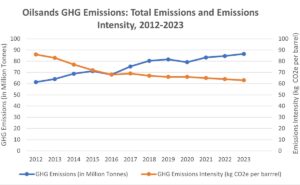
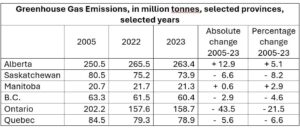
The claim on electricity emissions decline is directly attributable to changes brought about to decommission coal while the NDP was in power. Moreover, as the data shows renewable capacity gains was facilitated solely by policy changes of Notley’s NDP.
30 May 2025: Advancing North American energy dominance
In an all-hands-on-deck effort to showcase Alberta’s “position as a leader in responsible development,” a delegation of Alberta ministers (Smith, Neudorf, Jean) and parliamentary secretary Chantelle de Long were in Washington to “showcase Alberta’s position as a leader in responsible energy development.”
They will leverage their attendance at the Energy Council’s 2025 Federal Energy and Environmental Matters Conference, the U.S. Energy Streams 10th Washington Energy Forum and the S&P Global Oil Sands Dialogue to support Alberta in becoming a major global energy supplier.
Other key messages include “Alberta’s energy future is unstoppable and has a key role to play in helping the U.S. meet its growing energy needs and global energy dominance ambition.” Jean adds that Alberta can play a crucial role in North American energy dominance. A key message is “dominance” which is a favoured word used by conservative politicians indicating that we are not weak we will dominate.
The final line is “Alberta is implementing its Emissions Reduction and Energy Development Plan and offering a business-friendly environment primed for investment and growth.” Alberta is open to business and investment; indeed Alberta seemingly wants foreign capital without any qualification (e.g. coal in Grassy Mountain). This seems to imply that the GOA will support any investment even if it might mean environmental accommodation to the needs of “investment.”
04 June 2025: Investing in diplomacy to strengthen economic ties
This message underlines the importance of any and all diplomacy which advances Alberta “as a reliable partner in establishing U.S. food security, share best practices in agriculture and agri-food development.” While the subject matter was not oil and fossil gas, the theme of ever closer economic integration with the United States is unmistakable. Angela Pitt, backbench MLA for Airdrie-East and Glenn van Dijiken, MLA for Athabasca-Barrhead-Westlock will “reinforce the value of our trade relationship and promote the benefits of working together on critical trade corridors, including pipelines, to unleash Alberta’s ability to support the U.S. in its ambitions to become energy dominant.” Van Dijiken who represented a deeply conservative riding is also on the Alberta Next panel. The “Quick Facts” piece of the release provided a summary of Alberta’s trading relationship with the U.S. Clearly energy was also to be on the agenda.
The facts included that energy accounted for 88.7 per cent of total provincial exports of $162-billion of exports to the U.S. The U.S. is also an important source of industrial inputs and consumer goods for the province. Exported plastics totaled $4.3 billion, machinery $3.4 billion, meat (CAD $3 billion), organic (sic) chemicals and forestry products $2 billion, while “ag products” totaled $9.2 billion a four per cent increase from 2023.
Related Posts
Despite soaring profits, oil companies are not paying enough for their environmental damage
Alberta election: Is the province’s energy regulator acting in the public interest?
Energy company shareholders getting paid back after years of famine